Thursday, May 10, 2018

PCE Game 13 - Record of Lodoss War

Record of Lodoss War (ロードス島戦記) 
Released 7/17/1992, published by Hudson 

Lodoss War is one of the first anime I ever saw -- I rented it from Blockbuster on VHS. It originally came out of a tabletop RPG, which was then published in magazines in the form of "replays", which were basically just accounts of the gaming sessions. The franchise expanded to include novels, anime, manga, and several video games. The PC Engine game here is based on a PC-98 game although I don't know how closely the original game was followed. It has that "odd" feel that a lot of these early PC ports have (see Burai, La Valeur, Deathbringer).

The game opens with the vocal song Adesso e Fortuna (the above video is a cover; they seem to delete the original Japanese version aggressively). This is the first PCE game I've played on this blog that has a vocal song.
Our heroes

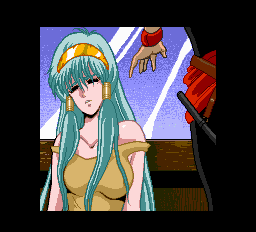
The main character is Parn, a "knight" (really just a sword user) who sets out to defeat Beld, who rules Marmo. This is a bit different from how the anime and source novels go. The first task, aided by Parn's friend and priest Eto, is to rescue a girl from goblins. There are voiced scenes like the one below; it shares the problem with Sol Menage that the speech is mixed too low with respect to the music and it's hard to hear what they're saying. I would have expected an emulation bug except that Japanese players complained about Sol Menage, and probably 3/4 of the games I've played are fine in this respect.
Parn and Eto
The towns are just a menu-based system. As usual you can't see the stats of items until you buy them, but it's usually fairly evident which ones are better. The battle system is an Ultima III-inspired style:
vs. two wolves
I often don't like this style of battle -- it takes too long and sometimes isn't very different from a standard battle. I actually thought it worked well in this game, though. The random encounter rate is fairly low, and you can easily restore MP by camping after a battle (you only regain a bit, but then you can take one step and camp again). This means you can actually use your spells, and many of them are useful. There are area effect spells or spells that hurt a line of enemies, and sleep/hold/silence spells that are actually worth casting.

On the way to the goblins we meet Deedlit, the elf:
Hello
She adds some good damage spells, and an area sleep spell.
Eat it goblins
Slayn has also joined there; after we find the mayor's daughter she's under a spell so we have to find Slayn to cure her. Now with 4 members of the party, it's on to the next area to see how we can fight against Marmo. One nice feature of the game is that you get a lot of XP for completing quests and events, lessening the amount of grinding you have to do. The enemies also drop good items to sell.
Ghym
Next to join is the dwarf Ghym, showing the clear D&D inspiration of the whole scenario. Of course Deedlit and he don't seem to get along. Next up is Woodchuck the thief, played by Wakamoto Norio. Now the party is complete. The battles start to slog a bit in this section, fortunately the game includes an auto battle that you can customize to tell the characters whether to use spells, items, etc. Often you can win battles by starting on manual until you have the battle under control and then use auto to finish it up.
The party
In the Alania kingdom we find a note in a thieves' hideout that says the king will be targeted by assassins. The only way to get the note to him is to enter a tournament. The first rounds are easy but the final spider boss is not.
The shade above the spider is Deedlit's summon
The king is happy to get our warning and lets us pass on to the next kingdom. There are two possible ways to get there -- Deedlit wants to take the forest route, Ghym the desert. Of course I have to follow Deedlit. Her village and house are in the forst
Apparently in the computer version this was a more explicit picture
Also in the forest is a house inhabited by a dark elf, working for Marmo.
Ooh la la
There are a lot of spellcasters in these battles, which makes the Silence and Hold spells particularly useful. If you can get all of them stopped, the rest of the battle becomes much easier. One complaint I had is that Etoh takes too long to get the next healing spell. Although it's cheap to buy healing potions that people can use for 50 hp heal so it's not terrible. There are also magic defense spells that help.
Now who's laughing


Once the dark elf squad is defeated, we get to Valis kingdom and meet the Grey Witch, played by my favorite seiyuu Sakakibara Yoshiko (of Haman Karn fame)
Mwahaha
She takes us all prisoner, but we escape, and find a princess along the way. Returning her to the grateful king gives us a big feast.
And experience too
This is about as far as I played. Judging from walkthrough sites this is about 2/3 of the game -- it's fairly short, and I considered playing the whole thing, but it's not a masterpiece. This is still theoretically superfamicomrpgs so I don't want to spend too much time on the PCE stuff. But I was pleasantly surprised by the battle system. It had a lot of chances to get bogged down, and although there are some balance issues, you have a lot of options in battle and it rarely works just to mash attack. But you can run from battles and the encounter rate is low enough that this isn't a big problem.

There's a sequel for the PCE which looks like it has similar gameplay. The later SFC game has no connection to these and is more console-ish from the looks of it.

Saturday, May 5, 2018

PCE Game 12 - BABEL

BABEL
Released 3/27/1992, published by Nihon Telnet
Nice NES-era title screen


This game pushes the border of what an RPG is; it technically qualifies as an RPG under my criteria but it has fixed level ups, meaning that at any point in the game, every player will have the same stats, HP, etc. You can grind money for equipment, but the only thing you can equip is weapons. You also can only save the game at pre-determined points. All of this makes the game much closer to an adventure game than an RPG, and I'm not going to play it much. The story is often praised, and it does seem to have a bit more substance than some other games from this period.

We begin with the two main characters, Zell and Alisa. They're voiced by the seiyuu for Shinobu and Sara from Dancouga, and I believe that other characters in the game have voices from Dancouga as well (and the personalities of the characters are similar).
Zell and Alisa
While they're riding along, they see a truck that has a kidnapped girl in it, so they go to save her. The first combat has Zell vs. a few grunts.
The battle system is very basic, but there is a brief animation every time you make an attack. Zell has both a knife and several guns, but here I just used the knife until he was gone. Then Alisa blows up a plane with a rocket launcher, and we save the girl


Sefia
Once they reach the capital, Sefia asks to have a gun as well so she can fight, and Alisa goes off somewhere while they try to figure out who Sefia is -- she won't talk much, but people are after her life.
Zell escorts Sefia back to the nunnery where she teaches, and that's pretty much where I stopped the game. The plot seems to involve some religious leaders fighting and probably wider issues than that. As I said, people commonly praise the storyline to this game, but I just don't think it has the spirit of an RPG -- if this were a Super Famicom game I guess I would keep playing it but for PCE I'll skip it and go on to Lodoss War.

Wednesday, May 2, 2018

PCE Game 11 - Tengai Makyo II Part 2

Ise and Kii are the locations for the second Orchid, and they're covered with profuse plants that have blocked access to a lot of areas and absorbed people into them. There's one village that has a sad scene with a mother and son who are crying for each other but forgetting who they are as the plants take them over.
Waaaa
The main goal of this area is to find four bronze bells in order to awaken an iron giant who can carry us over the plants to get to the final area where the next sword is stored. Kikugoro will be opposing us at every stage. The first step is to fish for a flute. This flute allows us to travel around on a ship of some sort that we can call up at the tombs seen below.

All of the bells are in Kii, but to get them we need a mirror that will activate some ancient statues. This is in the valley of lament, which we need the Iga Ninja's necklace to enter. After some fetch quests I got the mirror (which can be used in battle to reflect half of the enemy attack damage back at them). Then it was off to Kii and the valley of lament. In Kii I first met three female warriors that are on our side.
They don't join the team but show up periodically to help out.

The difficulty of the game increases quite a bit starting here. The enemies do a lot more damage, and coupled with the "main character 0 hp = game over" I found it rather frustrating. It's strange because the reviews I see praise the game balance, even though they mention that any random encounter can give you a game over. That doesn't sound like good game balance to me -- maybe these reviewers just like "hard" games.

With the mirror, now in various places around Kii I can use the mirror to activate statues, letting me in to places where the bells are. The first two are fairly easy to get; they don't have any dungeons or bosses, just visits to towns. But after that it starts getting harder. The next step is to get a boat (a real boat this time).
The problem, as I said in my last post, is that you can't get a game over or warp towns or the boat goes back to the beginning. This is rough here because you have to be able to sail over to a town, blow open the door, and complete the dungeon without game overs. After getting about 5 of them I got frustrated and did grinding to give Manjimaru a good sword that casts a spell on everyone. The main problem is that you have to fight these iron robot things, who take almost no damage from physical attacks. That just leaves spells, which seem to fail about 75% of the time. You can leave and rest after each enemy, but I was still getting game overs. With a few more levels and the sword I was able to defeat them and get to the roof, where Kabuki and Kikugoro have a transformation contest.
Godzilla!
Once Kabuki wins, Kikugoro gives up a key, allowing us to go to the next castle to find the third bell...after a boss fight.
Not very hard
The same key opens the fourth dungeon, with another boss.
This guy is bullshit; he can kill Manjimaru or Kabuki in one turn if you get unlucky. So this is another instant game over chance. But once I beat him I finally had all 4 bells.
Robot
The four bells awaken this Buddha-like being, so that we can finally make our way to the huge tree where the final showdown with Kikugoro is. There are multiple boss fights, ending with Kikugoro fused with the tree.
I had a really hard time with this fight; it was the same as the robots where I could barely hurt him, spells mostly failed, and I would run out of healing well before I did any damage. So I followed a strategy from a walkthrough -- have Kabuki use a technique that draws all attacks to him, and use the mirror to reflect Kikugoro's attacks. So most of the damage will be done by that. He's still hard but I managed to beat him and get the sword, to kill the second Orchid.

2 down, 5 to go. Next up is the capital city area, but this is where I think I'm going to stop. I've gotten somewhat beyond this but I find the game's difficulty too frustrating, and since PCE is supposed to be a side project I don't want to spend too much time on this game. I can see how this would have been a great game in 1992, but I wonder how much nostalgia and the amazing visuals and sounds make people forget the weaknesses of the system. Soon after this point, Kabuki leaves and you're alone, but the enemies still seem balanced for a party. I got about 15 game overs just trying to travel from one town to another.
The next party member, Gokuraku
Now, I'm going to make what might be an unpopular decision. One of the reasons I'm doing PCE games is that the PCE was the primary competitor to the Super Famicom in this period, and so it's interesting to compare what was being done on both systems. But that's hard to do when I'm a year behind on the PCE. So until I catch up, I'm going favor the PCE a bit -- maybe 3 games for each SFC game. I know this goes against the name of the blog but it's still retro chronogaming so it's still on topic, I guess.

Saturday, April 28, 2018

PCE Game 11 - Tengai Makyo II

Tengai Makyo II: Manji Maru (天外魔境II 卍MARU)
Released 3/26/1992, published by Hudson Soft

Tengai Makyo was a pretty good launch title for the PC Engine CD attachment, showing off what the peripheral could do with a lot of voiced dialogue and animated cutscenes (though not FMV). Three years later, a sequel arrived. This is often remembered as one of the best PCE RPGs and the best game in the Tengai Makyo series. 

It's disappointing that the system is more or less the same as Tengai Makyo 1. TM1's system wasn't bad for 1989, but it would have been nice to see them add some new features. As for the graphics, I feel like TM1's were actually better. The monsters, in particular, seemed more interesting in the first game, and for some reason TM2 took the backgrounds out of the battle sequences. However, I do think TM2 does more with the cutscenes than the first game did. The PCE tech didn't quite allow for FMV (although a few later games did it), but the cutscenes use a combination of still pictures and animation to create a feeling of movement and action that few games have. According to Wikipedia this was the most expensive game to develop at the time. It used the fairly new Super CD-ROM technology, which allowed for more RAM and possibly storage space on the CD.

It makes me wonder -- if you take out the speech and the orchestral music played off the CD, could this game have come out on the Super Famicom in 1992? I'm fairly certain that by the end of the SFC's life, studios that were making games like Star Ocean and even Tengai Makyo Zero would have been able to handle this, but maybe in 1992 they hadn't quite figured out the technology yet. Cutscenes are rare in SFC RPGs at this point -- I believe in what I've played up to now, only Light Fantasy, Villgust, 3x3 Eyes, and Elfaria did anything approaching animated cutscenes. 

Speaking of the music, the music director was Joe Hisashi, who might be familiar as the composer for many of the Miyazaki movies. Here's the overworld BGM, which does seem Miyazaki-ish:

So the game is above TM1 as far as music (TM1 had no CD tracks), cutscenes, amount of speech, and size/length of the game. I just wish they had put more time in developing the system -- I guess I shouldn't expect too much from 1992. Anyway, let's get into the game.

God
The opening scene has two beings, Mari and Yomi, create the land of Jipang on a certain planet. Fast forward many years to our main character, Manjimaru.
Manjimaru
He's a silent protagonist, but he seems to cause a lot of difficulty in the village and have a number of kid followers. Right now he wants to go see the festival at a nearby town. This gives the player the first view of the battle system.
A rabid dog
I like that you can see the enemy HP, but here's a battle scene from Tengai Makyo Ziria:

Tanuki
Why did they get rid of the great battle backgrounds for just colored bars? Anyway the battle system is basically the same as 1 and is just the basic AMID system. Characters do have some special techniques, and the one innovation (that was also in 1) is that you can trade magic spells freely among your party -- some spells can only be used by certain characters but most of them can be used by anyone.

At the festival, Manjimaru meets a rich Tycoon and three strange doctor-like beings but then an earthquake strikes.
Messengers from Yomi (the land of the dead and the red sphere in the first picture) arrive, as do seven huge plants in various parts of the world. They begin to grow, blocking travel and causing other mayhem.
The evil vine
The demons also capture Manjimaru's mom. He goes to save her, and meets the three doctor things again.
Mysterious beings
They seem to be enemies although they don't directly attack Manjimaru. Instead, they leave him to the first boss, Tsuno-Oh.
He goes down pretty quickly, and Manjimaru saves his mother. Once they're back at home, his mother tells him that he's actually a Fire Tribe person (as Ziria was in TM1). She also tells him of the legend that his father passed down.
The fire tribe
1000 years ago, these 7 plants appeared during a war between the Fire Tribe and the Root Tribe. Seven heroes from the fire tribe collected seven sacred swords to defeat the plants. So obviously the main goal of this game is to find those seven swords again to defeat the plants one more time. Manjimaru puts on his father's costume, and the main game begins.
Manjimaru the hero
First Manjimaru sets out for Owari Province. The entire first section is just Manjimaru, although he quickly meets the next party member (who will only join later), Kabuki Danjuro.
Kabuki Danjuro
He's named after Ichikawa Danjuro, a name held by a long succession of Kabuki actors (the most recent one died in 2013). Kabuki was so popular that the next game is a side story with him as the main character. You can probably tell his personality from the image above. There are a series of fetch quests leading up to the first of the seven swords, the oddest of which is to get an old man to draw you a ship:

Add caption
Which Manjimaru presents to a jizo statue to turn it into a real boat.
Sort of a real boat.

The boats in this game are quite annoying. If you get a game over (which doesn't force to you reload), use a warp spell, or save and quit, the boat returns to the place that you first get it. This is especially annoying in the second area. It's hard to see why they did this. The ultimate goal of this section is the demon castle.
Demon castle
Here Manjimaru has to fight all three of the skeleton bosses again, although they're the same strength as the first time they appear. The game balance is not all that great. Enemies tend to be either pushovers, or they can do huge damage. The way initiative works in this game, either you or the enemies often get two moves in a row. This makes it hard to heal in time. And once again this game makes the incredibly stupid decision to make it a game over if Manjimaru's HP reach 0 (even if other party members are alive). This should never be in a game. I don't care if it makes logical sense or even if it really fits well with the story or theme of the game. It also seems to be often combined with enemies that, if you get unlucky, can kill your character from full HP in one round (GDLeen, Jungle Wars 2, and this game all have enemies like this, and have instant game over from the main character hitting 0 HP).


Anyway, the final boss is a combination of all three of the skeleton bosses, created by those strange doctor beings.
Add caption
He's not very hard, though. Now Manjimaru gets the first of the seven swords, and can destroy the first of the "Dark Orchids".
No one can stand before me!
This also destroys the sword, which is good because inventory space is extremely limited in this game. Now with the first Orchid gone, the pathway to Ise province opens up. Here, Kabuki finally joins the team and we have a second party member. He's similar to Manjimaru in equipment but has a few special moves that aren't very useful. His MP are much higher, though. In a cutscene, the three doctors report to Yomi that Manjimaru is progressing, and they decide to try to use Kikugoro against him (Kikugoro is also named for a traditional kabuki actor).
Danjuro vs. Kikugoro
Of course Kabuki and Kikugoro don't get along.


I'm going to stop this post here -- I'm almost done with the second Orchid so I'll make a post about that for Monday or so. I think I'm going to continue playing this game if only because it's so well regarded by Japanese players. As I said, I think it's unfortunate that the system is still stuck in the NES era but the graphics and cutscenes are quite impressive.

Tuesday, April 24, 2018

Game 24 - Dual Orb Review

Story/Characters: The party characters barely exist -- they have names but virtually no backstories at all, and basically no dialogue in the game. Even the ones that do have backstories that sound interesting aren't really used much.

The story is probably the best part of the game, which is saying very very little. Overall it's not very good, but the Masho generals have little storylines surrounding them which involve the Pange they are keeping (e.g. jealousy, vanity). For 1993 it's an average RPG story, which means by overall standards it's not very good.

World: The world has an overworld, which is generic fantasy, and an underworld, with more steampunk style trappings. It's OK.

Game Flow: This is what sinks the game from "below average" to "terrible." Almost every decision they made in game balance was bad. There are way too many random encounters. The grunt enemies are too difficult and give too little XP and gold. Healing magic and items are limited. The dungeons are long. Your spellcasters have too few HP. The lack of strategic options means that your strategies are very limited, and mostly involve grinding or avoiding encounters.

 
System: This is the usual A-M-I-D. If you've played any RPG from this era you know what to expect.

Side Quests/Optional Content: None.

Interface: There's a unified use button, but the buying interface is annoying because they separated the pay counter from the shop itself, which serves no purpose. The battle interface is interesting -- you set your commands for everyone and then pick "attack"; you can just change the ones you want to change so it's a bit faster. There's also an autobattle, but getting out of the autobattle was not clear to me. Sometimes it worked, sometimes it didn't.

Graphics/Sound: As people pointed out in the threads, the graphics look like RPG Maker -- that's fine for this era, but nothing special. The music is OK.

All in all, this ranks down in the worst games I've played so far, along with Cyber Knight, Fist of the North Star 5, and Light Fantasy.

Next up is Elnard, better known to English players as The 7th Saga. Because some changes were made in the English version I had once thought to play this to see the difference, but another blogger has already done this, so please go read their post -- it's quite interesting. That means the next game up is Dragon Squad Danzarb, although first I'll be playing the PCE classic Tengai Makyo II, often considered one of the PCE's best games.

Saturday, April 21, 2018

Game 24 - Dual Orb Part 2 (Final)

After my first mandatory week of "play it as if it were on console," I pulled out most of the stops for a game this high on the crappiness scale. I'm using snes9x speedup, following a walkthrough, and I even used a cheat code for max gold. I'm hoping that will cut down some on the grinding time. There's also a "level 99 in one battle" code but I'm not going that far. I'll be interested to see that with this unlimited money code, can I beat the game without any actual grinding, just fighting the battles I encounter in the dungeons and on the world map? (Answer: no)
Recieving the Light of Lazes to open up the blocked town

After levelling up to 17 or 18 it was time to beat Gorlia, the boss of the overworld. Even at that level he casts an all-hit magic spell that does over half my HP, and the priest's healing is not enough to keep up with that. So basically we have to guard and heal until he runs out of MP. Even then his attacks do huge damage and the best I can heal is 80 HP (items only 30 HP, so useless). There's a lot of luck in this fight and boosting up defense and attack stats. Then I used a combination of attack spells and the fighters' special attacks, even though they can only use them once. Ralph and Liz only gain TP at certain points in the story, not from levelling.
Gorlia


Now that he's gone, it's time to head down to the underworld to defeat the 6 generals and Galba, and seal all the Panges. Once you enter the underworld you can't come back to the surface, and can never buy certain items again (most notably the Sun Shards which avoid encounters). So I stocked up with 99 Sun Shards and as many Life Winds as I could afford. I only ever ended up using about 30 of the sun shards and only 2 Life Winds.
99 sun shards, 14 life winds

In the underworld, we meet a resistance movement that wants to overthrow the Masho (generals) and Galba, but it will be up to Ralph to actually do it, of course. This is the point where I used the unlimited money code, so from this point on I was able to keep 99 of the healing items and the best equipment -- not that this helped a whole lot.
The resistance

However, this part of the game was at least reasonable. You get 80 HP healing items at this point, and with 99 of those it's actually possible to explore a dungeon while fighting the battles along the way. But you never get any better healing items, so after a while it becomes pretty much impossible. When regular grunt enemies have all-attack spells that do 120-150 to each person, or attack for 200, it doesn't take much math skill to see that 99 items that heal 80 hp aren't going to last very long with the high encounter rate. In the last third of the game, I used the technique of using Lumies' "no enemies" spell to get any treasures in the dungeon (most of which are worthless) then if there is a boss, use the Sun Shards to reach him. There's a good levelling place that works well even to the end of the game, so I would do my levelling there and then take on the bosses.


At this point I was also following a walkthrough step by step, including telling me how to get through the dungeons -- some of them are extremely long with multiple confusing passages, so this cut a lot of time off the game.

The first of the Masho is Geeter, who rebelled against Joshua castle and deposed the king. He has the "faithless" Pange; all of the generals have some emotion that matches with their Pange. The first step is to get a mine cart so we can use all the underground railroads to travel between cities. This involves some fetch quests, the worst one being a 17 floor dungeon(!!!). It's not that hard with a walkthrough, but many of the reviews of this game mention this dungeon as the breaking point for the players. With the mine cart we can now travel to other cities.
Off we go
The deposed king of Joshua Castle gives us the secret way into the palace, and Geeter is soon defeated.
Geeter
Next up is a pair of masho, Badish and Radish. Their town considers them heroes, and supports them. We have to convince the townspeople that we just want to check up on the resistance base, and they finally let us through. Of course Badish and Radish are behind the attack on the base, and defeating them yields the Betrayal Pange. The strategy against these double bosses is often tricky because they can kill anyone in one round. It's a combination of luck, buff items/spells, and using the fighters' special moves to at least take out one of them before you get completely annihilated. The healing isn't really enough to keep up with the damage so it can be pretty tough.
Badish and Radish
Next up is Gash, a fake priest that has stolen girls, although it doesn't say what he's doing with them. Defeating him releases the Ambition Pange. One of the girls was dead, though, and her mother tries to kill herself when we return to tell her -- fortunately someone stops her.

Gash
I was so tired of the game at this point that I didn't really get the story here -- it had something to do with two people who wanted to get married but are now dead, and some ceremonial jewels involved in their wedding. But I think I had to talk to more townspeople to get the full story. Anyway, the Masho is Sone Jina, who gives the Jealousy Pange.
Sone Jina
The last Masho is Eizel, who has the Vanity Pange. You need all the diamond equipment to fight him; I of course used a walkthrough to find the stuff but it seems hard to find without it. Maybe the townspeople gave some clues, but I wouldn't be surprised if this was yet another case where people have to buy the official guidebook to finish the game.
Eizel
Now with all the Pange sealed inside Ralph's orb, Dragon Lazes calls the party to a shrine where he opens the way to the final dungeon, where Galba awaits. I used the previous dungeons to level to 38 and then used Sun Shards to go through the entire dungeon with no encounters. As the game hinted earlier, Galba is Ralph's father, and apparently also the father of Liz and Teo, although I don't know where that came from. He believes that he's been doing the will of Dragon Lazes and Dragon Digbodinon (the dark dragon). At that point, Digbodinon orders him to kill the party.
Galba
I think I was overlevelled because he wasn't very hard. I spent a few turns just increasing attack and healing, and then continued to have Lumies increase attack while the fighters used their special attacks.

Once Galba is defeated, for some reason that removes Digbadinon's influence although they don't really explain why. Lazes praises the party, and reveals that Lumies was sent with the party because Lazes didn't trust humans, since they once betrayed him. But now he sees humans are trustworthy and goes into a long sleep, leaving the world in the care of the humans. He reminds us to not just believe in what we can see. The final scene is Galba joyfully greeting his children. Why? I don't know, it just ends right there.
The family reunited

All you get from this point is the credits, and then an odd "results" screen that shows how many times you pressed each button:
X, L, R, and select do nothing in the game.
Then a more typical results screen, showing number of saves, inns, deaths, etc. 1390 is the number of encounters I had, and that's with my heavy use of "no encounter" items and spells.
188 treasure chests opened


To put it simply: this game is horrid. The developers should be ashamed for releasing this and charging money for it. My timer at the end of the game was 30:35, and that was with the unlimited money, step-by-step walkthrough, and basically bypassing a third of the dungeons with a walkthrough and "no encounter" spells/items. I can't imagine the torture of playing this game on a real console without all this help -- and without the speedup key. My timer showed 30 hours, but with snes9x's speedup I was able to do 90 minutes of levelling in about 15 minutes so the actual time I put in was far less.
Fuck you.