
The story is fairly high quality in the game; IP titles haven't always had a good transition from the source anime, manga, or game, but in this case it looks like they did a decent job of keeping the original story in a fair amount of detail. It's not one of those games where if you don't know the original story or characters you're totally confused.
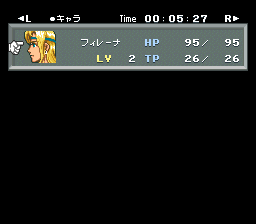
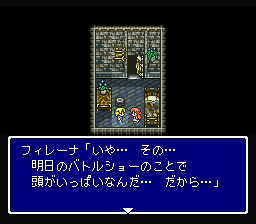
The background is that the entire world has been taken over by an Empire, who have divided the people into Imperial Citizens, Associated Peoples, and then the Krechia, who are slaves. The main character is Filerna ("Spirit of the Sea"), a Krechia girl who is living as a boy, fighting as a Battler in the arena for the enjoyment of the Imperial Citizens. She's been trained by her mentor Zena, who says he feels some hidden destiny in her. For now, she just has to win 10 battles in the arena so she can become a Megalo Battler. Tomorrow is her debut.
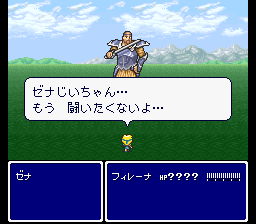
We can walk around the area and buy stuff, leave the town (although you can't go anywhere, just fight random battles). The right part of the town is where the Imperial Citizens live; they all just insult you and yell at you for being Krechia. The graphics are reminiscent of FF5 (4 years ago now). There are a number of interface issues in the game that really become an annoyance. You can't see what abilities the accessories have from the equip menu, only the item screen. You can't see the effects of items or skills in battle. When you use a healing spell or item, you can't see the current HP of anyone when you're asked to select the target. There are other little things like this that are really frustrating over the run of the whole game.
The day before the debut, all the new battlers are given wives from women Krechia who have been bred for this purpose. Each person selects their wife, and Filerna takes the last one left over, Lila. Lila tries to initiate sex but Filerna turns her down -- Lila protests that this is her role, and then wonders if she isn't pretty enough. But then she tries to get in bed with Filerna and finds out she's a girl, but they have to keep up the pretense of being "married" to hide Filerna's identity. (This is pretty explicit for a super famicom game!)
Next morning is Filerna's first fight.
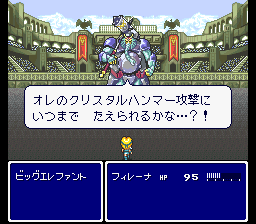
The battle system is fairly standard, but you have skills associated with each type of weapon (thrust, slash, hammer, crystal, and medical box). You learn skills as you level up, and can have 3 types of weapons equipped at a time, although hammers and some of the stronger spears take up 2 slots. These skills all take TP. The battle system is ATB like FF4/5/6, and you can see the meter fill up for your turn. Skills then take a certain amount of time to use (which will be shown as a yellow bar above the turn gauge). Overall it's not a bad system, although you need an item to find out the weaknesses of monsters and on the whole I think the balance is not as good as it could be (the random encounters are too difficult for the resources you have).
After winning the first battle, Filerna gets a house with Lila and continues to fight the other battlers. As she beats them, she becomes better known. The second fight was annoying because the guy can use healing for 300 HP, and once you run out of TP it becomes impossible to keep up with that. I had to level a bit until I could defeat him before he started using heal. Meanwhile she can train with Zena. She also meets Nest, a "story writer" for the battles. After beating all the debut people, Filerna hears that she's going to be fighting her long-lost brother. But Nest tells her that's just for the story, it's not actually her brother.
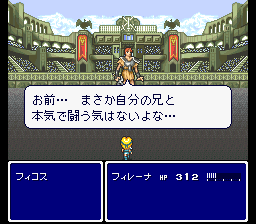
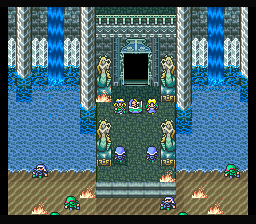
Filerna sees an image of 16 years ago when the Firosera kingdom was conquered by the Empire. The King and Queen of Firosera sent away their daughter Filerna as well as the Sword of Filerna, and then they sink the palace into the ocean. But after seeing this, the computer warns that they've seen a top secret Imperial information, and alarms begin to go off. Nest and Filerna have to escape the command center. There is a healing spot -- because I found the random encounters fairly unbalanced, I tended to grind near these healing spots and then run away from other encounters. That's never a good sign for a game.
Reaching the bottom of the command center area, we meet the first of the Black Demons who are a major threat throughout the first part of the game. This is Balba #2.
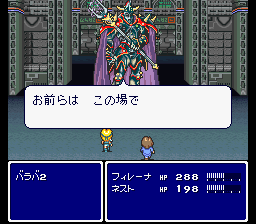
At first I thought this was an auto-lose story fight, but it's just hard -- Crystal attacks do extra damage, but I did have to grind a few levels to beat him. Now Filerna heads back to her house to collect Lila, but Milika (the widow) is waiting for her there. She throws some kind of acid in Filerna's face, blinding her. Don't put her at the head of the party after this because every step will make this annoying graphical change and she's going to be blind for quite a while.
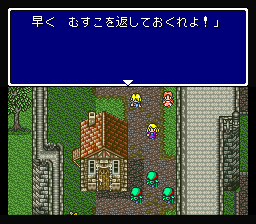
Apparently Milika did this because Fis (her son) is held hostage (and because she wants revenge), but of course the soldiers have no intention of returning Fis. It's time to escape the town, although the Black Demons have a transmitter in the acid bottle so they can hear our conversation. Milika wants to stay to save Fis, but Nest convinces her to run away. We escape through the battler residence, which the Black Demons try to burn down. But Nest knows a secret way out.
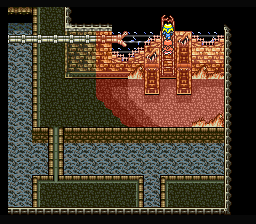
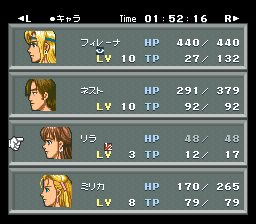
We come out in a different town, and have to find an eye doctor for Filerna. Here we have someone named Dr. Kill, which doesn't inspire confidence. But he does surgery on Filerna's eyes which I guess help, but she still has to keep the bandages on until her eyes completely heal. Now it's time to set out for the Empire's capital, Bow. Since they're being hunted, the way they decide to try this is for the women to pretend to be Mimezu, who are strange cult members that do a religious dance to the capital in these cat costumes. Nest stays behind.
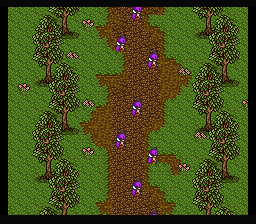
Although they manage to get in the group, the Black Demons are still aware of where they are and have one of their number ready to attack. The party tries to escape over a bridge, but Balba #7 has a bomb ready to blow it up. Milika had lagged behind, though, and is able to come up from behind and push him off a cliff. Unfortunately the bridge blows up too, and Milika falls to her death, leaving behind her flute. Filerna and Lila are sad of course, but they continue on (this is a dark story!)
Next they come to a snowy place and a cave which is inhabited by a resistance army of Krechia fighting against the Empire.
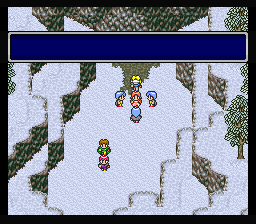
But the Empire is still on to our trail, and we soon have to fight Barba #8 as the Empire forces attack.
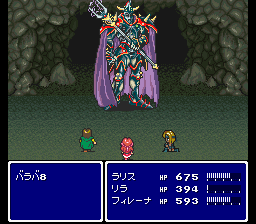
Afterwards, we escape through the back of the cave and continue to the hidden village in the middle. Here, the resistance lives. They grow a lot of herbs and Filerna is able to get more help with her eyes from the herbalists here. After some fetch quests the herbalist is able to heal Filerna's eyes (I guess the previous surgery didn't work?) but she still has to have the bandage on until it's completely healed. Meanwhile the Black Demons are still chasing us (they're not very good at their job). As the Empire attacks, Filerna finally decides it's time to take off the bandage, and she can see again.
While the resistance group takes on the Empire, Filerna flees through the back on some mine tracks.
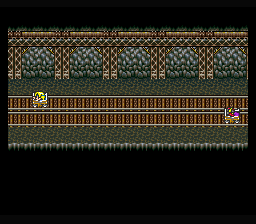
They're pursued by more Barabas, and eventually have to fight #14. After that the mine truck goes off the rails and sends Filerna and Lila get knocked unconscious but are picked up by a friendly old man. Now we continue our journey to the capital bow, although this requires taking a ship across the sea. Apparently the Empire isn't very good at ships, but we'll have to sneak on to this one to get across a small channel. The plan works, and we're continuing on. (Another Japanese blogger pointed out that the Krechia seem to have a lot more freedom after that initial town -- they're not really slaves outside of there. People insult you, but you can freely enter and exit places, buy equipment, etc.)
Our next goal is to make it through a mining town. The mine area is poisonous so we have to wear special clothes to not die.
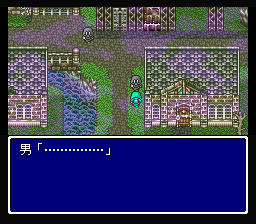
Here we just have to fool the soldiers into thinking we work in the mine, to be able to pass. But, in Toma (the poison town) we come face to face with Fis again (the son of the widow Milika from before). He's being used by the Empire for some kind of scientific experiments. But the Barabas reappear and we have to escape (yet again) through an underground passage while they burn a house down.
This is a chokepoint where I had to raise a bunch of levels, but there's a healing pool and the enemies give a lot of XP. Eventually I had enough levels for the next Crystal power which helped against the next boss, Baraba #17.
 |
| Filerna and Lila art |
Now the journey to Bow continues. We start coming across Black Market areas at this point. They often sell expensive better stuff, and they have people who will trade 10 of various items (bone, etc.) for a special piece of equipment. Continuing on, we pass through a beach where Filerna and Lila meet Amanera and her dog (lots of female characters in this game). She's pregnant; normally Krechia can't give birth without permission but she's defying that (once again, the idea that no Krechia in the world can have kids seems not to fit with the level of freedom you see Krechia have in this game).
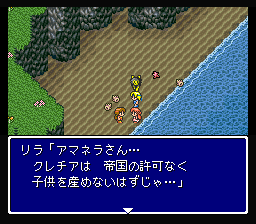
Amanera lives in a town of travelling shepherds. While here, a cutscene shows us that the Krechia resistance army has grown so much that it's now openly fighting the Empire, which is worrying the Black Demons (who once again seem pretty ineffective as they continue to try to find Filerna). Meanwhile Amanera gives birth to her child, and we have to deal with a group of Krechia Hunters that are trying to capture the Krechia (to become slaves I guess). Gappy the dog also joins the party.
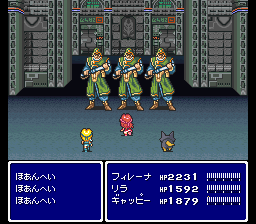
Afterwards we're able to sneak into a cart of wood that a woodseller is taking to Bow, and thus infiltrate the capital. I'll end the post here -- I may finish the game tomorrow but this is a good breaking point.
Overall the game is OK; I wish the interface were better and the battles a little more forgiving. The story is entertaining despite the bumbling villains.


